
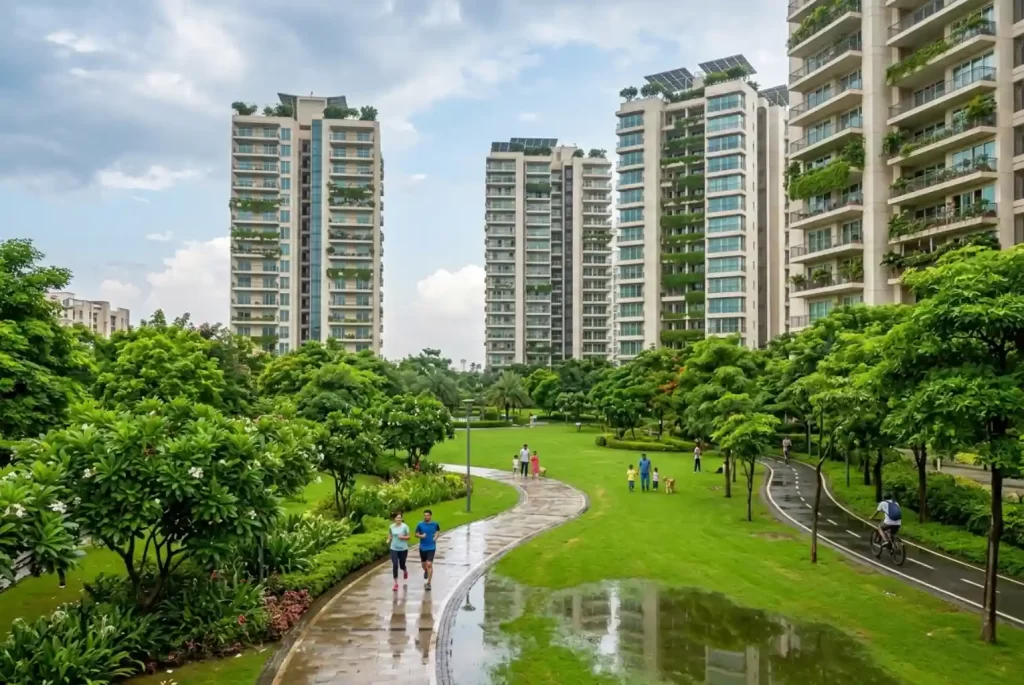
Choosing a home in Delhi is no longer just about location and price. More buyers and tenants now ask a different question: which high-rise areas in Delhi offer clean air, real greenery, and a healthier lifestyle? Delhi’s pollution and heat have pushed families to look beyond square footage and metro distance. They want tree-lined streets, working parks, and buildings that don’t trap heat and dust.
This guide breaks down the best green localities in Delhi for high-rise living, explains why green cover and rainwater retention matter more than most buyers realise, and points out the mistakes people make when they judge a locality only by its brochure photos.
Why Green Cover and Rainfall Matter When Choosing a High-Rise Home in Delhi
Delhi’s air quality index (AQI) regularly crosses 300 during winter, and the city’s tree cover is not evenly spread. Areas with a higher density of trees and open ground behave differently from concrete-heavy pockets. Trees pull dust and particulate matter out of the air, break wind-driven pollution, and slow down surface runoff during the monsoon, which lets rainwater percolate into the ground instead of flooding the streets.
This directly affects your groundwater table, your building’s rainwater harvesting efficiency, and even the local microclimate around your society. A high-rise apartment in Delhi surrounded by mature trees and parks stays cooler in summer, floods less in the monsoon, and reports fewer respiratory complaints among residents, according to multiple resident welfare association (RWA) surveys across South and West Delhi.
The Delhi Development Authority (DDA) and Municipal Corporation of Delhi (MCD) have also pushed green building norms and mandatory rainwater harvesting systems for new high-rise projects, so newer towers in these belts are better equipped to handle both heat and heavy rain than older, densely packed colonies.
Top High-Rise Areas in Delhi for Greenery and a Healthier Lifestyle
Here are the localities that consistently rank high for tree cover, open space, and liveability among Delhi’s high-rise residential areas.
1. Vasant Kunj
Vasant Kunj sits next to the Aravalli Biodiversity Park and Mahipalpur forest ridge, giving it one of the highest green covers in South Delhi. The area has several DDA high-rise apartments and private group housing societies with wide internal parks. Proximity to the ridge forest also means slightly cooler evenings and better air circulation compared to central Delhi.
Good for: families and professionals who want South Delhi high-rise living with easy airport and Gurgaon access.
2. Dwarka
Dwarka is a planned sub-city with wide roads, dedicated green belts between sectors, and one of Delhi’s better rainwater harvesting track records because most societies were built after the norms became mandatory. Sectors like 6, 7, 10, and 12 have younger tree cover but far more open, walkable space than older Delhi colonies.
Good for: buyers who want a modern high-rise society in Delhi with structured planning over old-world charm.
3. Chattarpur and Chattarpur Extension
Chattarpur borders the Southern Ridge and has seen a wave of new luxury high-rise apartments built with larger green setbacks. The proximity to the ridge forest gives the area noticeably better air quality readings on most days compared to Central and East Delhi.
Good for: those who want a quieter, greener high-rise locality without moving out of Delhi city limits.
4. Rohini
In North-West Delhi, Rohini offers large DDA housing societies with mature trees, especially in sectors developed in the 1990s. Japanese Park and Rohini’s several district parks give residents genuine green lung space, and the area’s wider roads help with rainwater drainage compared to older, narrower North Delhi lanes.
Good for: middle-income families looking for an affordable green high-rise area in Delhi.
5. Vasant Vihar and Chanakyapuri
These diplomatic-belt localities have some of the lowest population density and highest tree cover per resident in the entire city. While most housing here is low-rise, the newer high-rise developments on the periphery benefit from the same green buffer, cleaner air, and better-maintained storm drains.
Good for: premium buyers who prioritise clean air and open space over central-Delhi convenience.
6. Hauz Khas and Green Park
Anchored by Deer Park and the Hauz Khas forest patch, this belt combines urban greenery with strong social and retail infrastructure. Tree-lined internal roads and low-rise blocks surrounding the newer high-rise pockets keep the air noticeably fresher than in commercial-heavy zones nearby.
What Makes These Areas Better for Rainfall Retention and Air Quality
It’s worth being precise here: no locality in Delhi gets meaningfully more monsoon rainfall than another purely because of its address. What changes from one area to another is how well the ground absorbs and retains that rainfall, and how much dust and heat the surrounding greenery filters out. The localities above score better on three practical factors:
- Tree canopy density — reduces surface temperature and traps particulate pollution before it settles into residential blocks.
- Permeable open ground and parks — lets rainwater soak into the soil instead of overwhelming storm drains, which cuts down on local waterlogging.
- Newer rainwater harvesting infrastructure — mandatory for group housing societies approved after 2001 under DDA and Delhi Jal Board norms, so newer high-rise belts like Dwarka and Chattarpur Extension tend to comply more consistently than older colonies.
Common Mistakes to Avoid When Choosing a High-Rise Green Locality
- Judging greenery from brochures alone — visit the society in person, ideally during peak summer or right after rain, to see how the area actually handles heat and water.
- Ignoring the building’s age and RWA maintenance record — a green locality with a poorly maintained society still means blocked drains and dead landscaping.
- Overlooking floor-level ventilation — high-rise towers facing the ridge or a park get better air flow than towers boxed in by other blocks.
- Skipping a site visit during monsoon — waterlogging patterns are often invisible in the dry season but obvious after the first heavy spell.
- Not checking rainwater harvesting compliance certificates — ask the builder or RWA for the Delhi Jal Board compliance status before finalising.
Documents, Costs, and Timelines to Keep in Mind While Relocating
Once you shortlist a high-rise society in Delhi, keep these practical steps in mind:
- Sale deed and society NOC: verify these before booking any moving date, since possession delays are common in newer high-rise projects.
- Local shifting costs: a 2BHK relocation within Delhi typically costs between ₹8,000 and ₹18,000 depending on floor level, lift access, and distance, while high-rise moves without a functioning goods lift can add 15-20% to labour charges.
- Timeline: budget 3-5 working days for a full home shift including packing, transport, and unpacking; high-rise societies often require a written move-in slot booked in advance with the RWA or facility management team.
- Utility transfers: electricity, water, and piped gas connections in newer high-rise belts like Dwarka and Chattarpur Extension usually take 5-7 working days to activate under the resident’s name.
Why Professional Relocation Services Can Help
Moving into a high-rise apartment comes with logistics that a regular local move doesn’t: lift booking slots, society move-in timing rules, narrow stairwells during power cuts, and stricter security checks at the gate. Professional relocation services handle all of this on your behalf.
An experienced packers and movers team will coordinate directly with the RWA for lift access and move-in windows, use the right packing material for fragile items during elevator transport, and plan the move around monsoon or peak-summer weather so your belongings aren’t exposed to heat damage or sudden rain.
For families relocating from outside Delhi, a full-service relocation company also manages vehicle transportation, temporary storage if your new high-rise flat isn’t ready, and documentation support for society registration. This removes the guesswork and reduces the physical strain of coordinating a high-rise move on your own.
Conclusion
Delhi’s best high-rise areas for greenery and a healthier lifestyle, Vasant Kunj, Dwarka, Chattarpur, Rohini, Vasant Vihar, Chanakyapuri, and Hauz Khas — share three things: strong tree cover, better rainwater absorption, and newer infrastructure built around environmental norms. None of them will change the city’s rainfall pattern, but all of them handle heat, dust, and monsoon runoff far better than Delhi’s older, denser pockets.
If you’re planning a move to any of these localities, factor in the extra logistics that high-rise living demands, and consider working with a professional relocation service to make the transition smooth.
Frequently Asked Questions (FAQs)
Which is the greenest high-rise area in Delhi?
Vasant Kunj and Chattarpur rank among the greenest due to their proximity to the Aravalli ridge forest, which gives both areas noticeably better tree cover and air quality than central Delhi.
Do any areas in Delhi actually get more rainfall than others?
Rainfall distribution across Delhi is fairly uniform during the monsoon. What differs between localities is how well the ground and drainage systems absorb that rainfall, not the volume of rain itself.
Is Dwarka a good option for a high-rise home with greenery?
Yes. Dwarka’s planned layout, wide green belts between sectors, and newer rainwater harvesting compliance make it one of the more liveable high-rise sub-cities in Delhi.
How much does it cost to shift to a high-rise flat in Delhi?
A local 2BHK shift typically costs ₹8,000 to ₹18,000, though buildings without a functioning goods lift or with limited move-in slots can push labour charges up by 15-20%.
What should I check before booking a flat in a green, high-rise locality?
Visit the society during summer and after a monsoon spell, check the RWA’s maintenance record, and confirm the rainwater harvesting compliance certificate with the Delhi Jal Board.
How can professional movers make a high-rise relocation easier?
They coordinate lift bookings and move-in slots with the RWA, use elevator-safe packing methods for fragile items, and plan around monsoon or peak-heat weather to protect your belongings during transit.
Are newer high-rise buildings in Delhi better equipped for monsoon flooding?
Generally yes. Group housing societies approved after 2001 are required to have rainwater harvesting systems under DDA and Delhi Jal Board norms, which reduces local waterlogging compared to older colonies.