
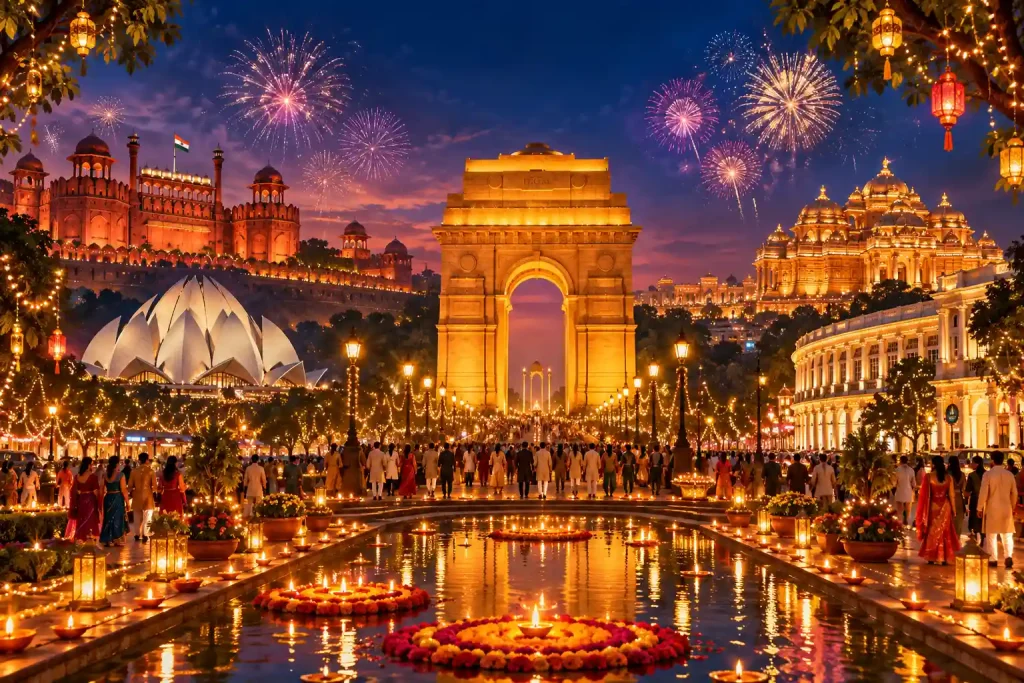
Celebrate Diwali 2026 in Delhi by exploring the city’s most beautiful festivals spots and attractions. This guide covers 15 top places where you can enjoy lights, culture, and fun during the festival of lights. You will find famous temples, markets, community melas, and more. We also share tips on travel, safety, and what to expect. Whether you’re a local or visiting Delhi, this article will help you plan a memorable Diwali.
Top 15 Places to Celebrate Diwali in Delhi
Swaminarayan Akshardham Temple
Swaminarayan Akshardham is a spectacular Hindu temple famous for its Diwali illuminations. During Diwali, the temple complex is lit up all night with thousands of lamps and light displays. Akshardham draws very large crowds – tens of thousands of people come for the evening program. To avoid the long queue, plan to arrive by late afternoon (around 4 PM). The temple grounds are free to enter, but special attractions like the cultural exhibits, boat ride, and evening water show require tickets (usually a few hundred rupees). Don’t miss the water show after sunset – it features music, lights, and fountains that tell stories of Indian culture. Note that Akshardham follows strict security: you cannot bring cameras or big bags inside. Dress respectfully (cover shoulders and knees) to enjoy the peaceful, beautifully crafted architecture.
Chandni Chowk (Old Delhi Markets)
Chandni Chowk is Old Delhi’s famous bazaar, known for its busy shopping streets and historic charm. During Diwali, the narrow lanes light up with diyas (oil lamps), lanterns, and festival decorations. This is a great place to shop for sweets, gifts, and decorations. The Kinari Bazaar area in Chandni Chowk has many shops selling diyas, cotton wicks, and rangoli colors at wholesale prices. (For example, you can get earthen diyas up to three times cheaper than in malls.) Try to visit a few days before Diwali to avoid last-minute crowds. Chandni Chowk also has famous food spots (like Paranthe Wali Gali) where you can taste traditional Diwali snacks and sweets. Note: The streets get very crowded before Diwali, so go early or use the nearest Metro station (Chandni Chowk, Jama Masjid, or Chawri Bazar) to avoid traffic.
Gurudwara Bangla Sahib
Gurudwara Shri Bangla Sahib is one of Delhi’s most important Sikh temples, located on Hanuman Road near Connaught Place. On Diwali, this gurudwara offers free langar (community meal) and is beautifully lit at night. Sikhism celebrates Bandi Chhor Divas on Diwali, and Bangla Sahib holds special prayers and community kitchens during the festival. The atmosphere here is peaceful and welcoming – everyone, regardless of religion, can join the worship and free food. Gurudwaras like Bangla Sahib do not charge any entry fee, and visitors can walk around the marble courtyards and the holy pond. (If you go, cover your head and dress modestly as a sign of respect. Headscarves and disposable covers are usually available at the entrance.)
Gurudwara Rakab Ganj Sahib
Another must-see Sikh temple is Gurudwara Shri Rakab Ganj Sahib, near the Parliament. It also serves an open langar during Diwali evenings and stays lit late into the night. This gurudwara is linked to Bandi Chhor Divas (celebrating Guru Hargobind’s release), and special hymns (kirtan) and prayers are performed on Diwali night. Like Bangla Sahib, Rakab Ganj does not charge for entry and welcomes everyone. The bright silver and gold domes look striking when illuminated. Many Delhiites stop here after evening puja at other places. Visiting these gurudwaras gives a glimpse of the Diwali celebration from the Sikh faith perspective.
Ramlila Grounds and Melas
Ramlila Ground (near Laxmi Bai Nagar and Hindu Rao) is famous for its annual Diwali mela (fair). Throughout October and early November, the grounds host large fairs with cultural performances, plays of the Ramayana, and craft stalls. You can see beautiful diya exhibitions and rangoli competitions where local communities display rows of lit lamps and colorful floor art. These open-air fairs are family-friendly and often free to enter. You’ll find food vendors, handicrafts, and sometimes big swings or games for kids. It’s a lively way to experience traditional Delhi Diwali culture. (Tip: These melas can get very crowded on weekends and festival days, so go early if possible.)
The Bazaar’s Diwali Mela at Sunder Nursery
Sunder Nursery (near Humayun’s Tomb) hosts a festive fair called “The Bazaar’s Diwali Mela”. This heritage park is turned into a market with boutique stalls of handicrafts, textiles, and decorations. The décor is very photogenic, with lanterns and fairy lights in the garden. You can enjoy live music and performances in a relaxed family-friendly atmosphere. Entry is usually free or a small charge. This place is great for a leisurely evening stroll: combine it with a visit to nearby Humayun’s Tomb (famous for its Diwali illumination too), and enjoy street food from the park’s cafe vendors.
Meri Dilli Utsav at Dilli Haat Pitampura
Dilli Haat in Pitampura (North Delhi) holds a Meri Dilli Utsav during the Diwali season. Dilli Haat is an open-air craft bazaar; it charges a small entry fee (about ₹30 per person), and then you can shop for crafts from all over India. During the festival, this market features extra stalls, cultural performances on a stage, and special food carts. You’ll find ethnic wear, jewelry, home décor, and delicious street food like chaats and sweets. The theme is “culture and shopping under one roof”. It’s a good place to pick up unique gifts or enjoy folk dance shows in the evenings. (Pro tip: Plan to get there by sunset, because it looks extra beautiful with lights once dark.)
Blind Relief Association Diwali Bazaar (Lodhi Road)
Along Lodhi Road, the Blind Relief Association organizes a famous Diwali mela every year. This is a special fair run by visually-impaired artisans. It features rows of handmade candles (diyas), festive decorations, lampshades, and stitched handicrafts – all created by blind craftsmen. Shopping here means you’re also supporting a good cause. The atmosphere is festive, with candle-light decor and sometimes live music. The market usually runs a few days to a week before Diwali and is free to enter. Don’t miss the wide candles in colorful jars – they’re popular items to light your home. This event is an insider favorite for unique Diwali finds.
Ramakrishna Mission (Ramakrishna Ashram Marg)
For a quieter visit, the Ramakrishna Mission temple complex on Ramakrishna Ashram Marg offers Diwali puja and meditation. It’s less crowded than the big temples, focusing on spirituality. On Diwali, they decorate the shrines with lamps and flowers, and devotees gather for evening worship. The atmosphere is peaceful, ideal for those seeking a reflective experience during the festival. It’s open to everyone and there is no entry fee. (Pro tip: Combine this with a visit to the nearby Jhandewalan Hanuman Mandir, which is very popular on Diwali for its 84-lakshmi idols.)
Qutub Minar and Mehrauli Archaeological Park
While not a Diwali event per se, Qutub Minar is a top attraction in Delhi that is worth visiting around the festival time. The 73-meter tall minaret, built in the 12th century, is one of India’s UNESCO heritage sites. It often hosts a sound and light show in the evenings (check local listings for show dates), and the surrounding park is especially pleasant in winter evenings after Diwali. You can walk around the historic ruins and enjoy the outdoor grounds. (If you visit on Diwali night, some tourists combine it with the Akshardham lights or Book a dinner at nearby bars – Qutub’s area has many restaurants.) Ticket prices for the monument are low (a few rupees for Indians, slightly higher for foreigners), and it’s open late (usually until 7 PM or later). Always cover shoulders and legs as it is a monument with some religious context.
Lotus Temple (Baháʼí House of Worship)
The Lotus Temple is another serene place to visit in Delhi. It’s known for its flower-like shape and tranquil ambiance. During Diwali, it’s beautifully lit from inside at dusk, creating a calm spectacle (the temple is open Tuesday–Sunday, including Diwali evenings). There is no entry fee. Visitors of all religions are welcome to sit in quiet meditation. The temple grounds and fountains are a peaceful break from the Diwali crowd. It’s especially nice after dark when the white marble glows under soft lighting. (Remember to cover shoulders and knees – since it’s a place of worship, there is a simple modesty rule.)
India Gate and Rajpath
India Gate is a central landmark in Delhi. Though not a Diwali-specific event, the whole area (including the Rajpath lawns) is a popular evening outing. In the days around Diwali, many families drive to India Gate to see it lit up and enjoy street food under the lit-up gate. The lawns are open late during holiday times. You might also catch local festivities or music around National War Memorial nearby. The spot is great for evening strolls. Note: On Diwali night, large firework displays are sometimes held near India Gate (depending on government rules and pollution conditions), but even if not official, the vicinity can still be lively. Parking is limited, so go early or use the nearest Delhi Metro (Central Secretariat or Patel Chowk).
Connaught Place and Janpath Markets
The circle of Connaught Place (CP) gets decorated for Diwali, with lights strung in its central park and fair stalls near Janpath and Jantar Mantar areas. Many shops and malls around CP run Diwali sales, and you can find festival deals on clothing and jewelry. The heritage theater (DMRC), and the State Emporia (on Baba Kharak Singh Marg) often host craft exhibitions. A favorite in CP is the famous Navrang restaurant for special Diwali thali. Even simply walking around the colonial arcades and side lanes (Kashmiri Gate end of CP) to see lights and street food is fun during Diwali evenings. Use Rajiv Chowk Metro to reach CP easily; on festival nights the metro runs frequently.
Birla Mandir (Lakshmi Narayan Temple)
Birla Mandir, on Mandir Marg near Gole Dak Khana, is a historic temple dedicated to Lord Vishnu and Goddess Lakshmi. It is especially popular on Diwali. The mandir is brightly illuminated and fans decorate the courtyard with lights. Locals visit at night for Lakshmi puja (prayer to the goddess of wealth). The architecture is beautiful and the interior is filled with silver and gold idols. There is no entry fee, but it can get crowded, so plan to go late at night or early dawn. The Birla Mandir complex also has a small garden where many families light sparklers and enjoy the atmosphere. It closes around midnight on Diwali.
Paranthe Wali Gali, Chandni Chowk (Food Street)
Lastly, no Diwali trip is complete without tasting Delhi’s food. Paranthe Wali Gali in Old Delhi (Chandni Chowk) is famous for its stuffed parathas (flatbreads). On Diwali, the street is open late and decorated with lights. You can try long queues of locals waiting for sweet lassis and parathas. Nearby, there are also shops selling khas (a sweet made from vetiver) and jalebis (a crispy sweet) to celebrate. The smell of ghee and sugar here is part of the Diwali vibe. It’s not a “sight” but a must-do for the taste of Delhi during the festival.
Why Professional Relocation Services Can Help
Moving to a new home or city can be especially hectic around Diwali season. Professional movers and packers make the process much easier and safer. Here are some reasons why:
- Professional packing: Movers have quality boxes and materials. They can wrap delicate items (like lamps, glassware, or electronics) so nothing breaks in transit.
- Safe loading and unloading: Trained crews use proper techniques and tools to lift heavy furniture and appliances. This prevents damage to your things and keeps movers safe.
- Door-to-door transportation: Movers provide a truck and driver that go straight from your old place to the new home. You don’t have to manage multiple steps.
- Insurance assistance: Many moving companies offer insurance or help you arrange it. This means if anything is lost or damaged, you have help to claim its value.
- All paperwork and tracking: Good movers handle the necessary documents (like bills of lading) and give you a tracking number. You can follow your shipment and know when to expect it.
- Bulky or fragile items: Professional teams know how to dismantle large furniture (beds, cabinets) and pack odd-shaped objects (mirrors, statues) securely. They use blankets, foam, straps – things you might not have.
- Reduced stress: Hiring movers lets you focus on your family and celebrations. You won’t have to worry about the heavy lifting or logistics. They plan the move date and time around your schedule, making relocation smooth.
Using a corporate relocation service or moving company doesn’t mean you lose control. You still guide where everything goes. But the packing, loading, and driving are done by experts. This means fewer surprises on moving day, and more time for Diwali celebrations!
Frequently Asked Questions
FAQ 1: When is Diwali 2026 in Delhi?
Diwali in 2026 falls on Sunday, 8 November 2026. That day is Lakshmi Puja (the main Diwali night). The full festival of five days runs from 6th to 10th November (Dhanteras through Bhai Dooj). Plan your trip or visits to Delhi with those dates.
FAQ 2: Which places are best to visit in Delhi during Diwali?
Top spots include Swaminarayan Akshardham Temple (spectacular light displays), the Old Delhi markets like Chandni Chowk (for diyas and sweets), Sikh Gurudwaras like Bangla Sahib and Rakab Ganj Sahib (special Diwali prayers), and large Diwali melas at Ramlila Ground, Dilli Haat, and Sunder Nursery. These places are lively with decorations, food, and cultural programs.
FAQ 3: Can we burst firecrackers in Delhi during Diwali 2026?
Delhi strictly regulates fireworks. As of 2026, the Supreme Court has allowed only “green crackers” (low-smoke types) on Diwali, typically between 8 PM and 10 PM. Traditional firecrackers are banned. To comply, buy only NEERI-approved green firecrackers and light them only during the permitted hours. Follow local announcements in late October for any updated orders.
FAQ 4: Are temple entries free during Diwali?
Yes, most temples and gurudwaras in Delhi charge no entry fee. You can visit places like Bangla Sahib, Rakab Ganj, Birla Mandir, Lotus Temple, and others for free. (The only cost is optional donations.) At Akshardham Temple, the main courtyard is free, but exhibitions, the boat ride, and the famous evening water show require paid tickets. Always check timings in advance, as many temples have extended hours during Diwali.
FAQ 5: How can I travel around Delhi during Diwali?
Expect heavy traffic and crowded roads. It’s best to use the Delhi Metro whenever possible. Many Diwali venues (Akshardham, Chandni Chowk, Dilli Haat) are near metro stations. Authorities usually add extra metro and bus services during festivals. Driving is harder: parking fees may rise and traffic police set up diversions. If you do drive, leave very early or plan to park at least a 1–2 km away and walk. Also, carry a mask for air pollution.
Conclusion
Delhi comes alive during Diwali 2026 with lights, markets, and celebrations at every turn. We have covered 15 top places to visit, from the grand Akshardham Temple light show to bustling Old Delhi bazaars, sacred gurudwaras, and colorful Diwali melas. To enjoy the festival smoothly, plan around local rules: expect crowds, follow traffic advisories, and use public transport. If you are moving or relocating around Diwali, hiring professional movers can save you from stress by handling packing, transport, and more. Whatever you choose, Delhi’s Diwali offers a unique mix of tradition and fun. Experience the lights, rituals, and flavors, and take home memories of a bright and joyful Diwali in India’s capital!