
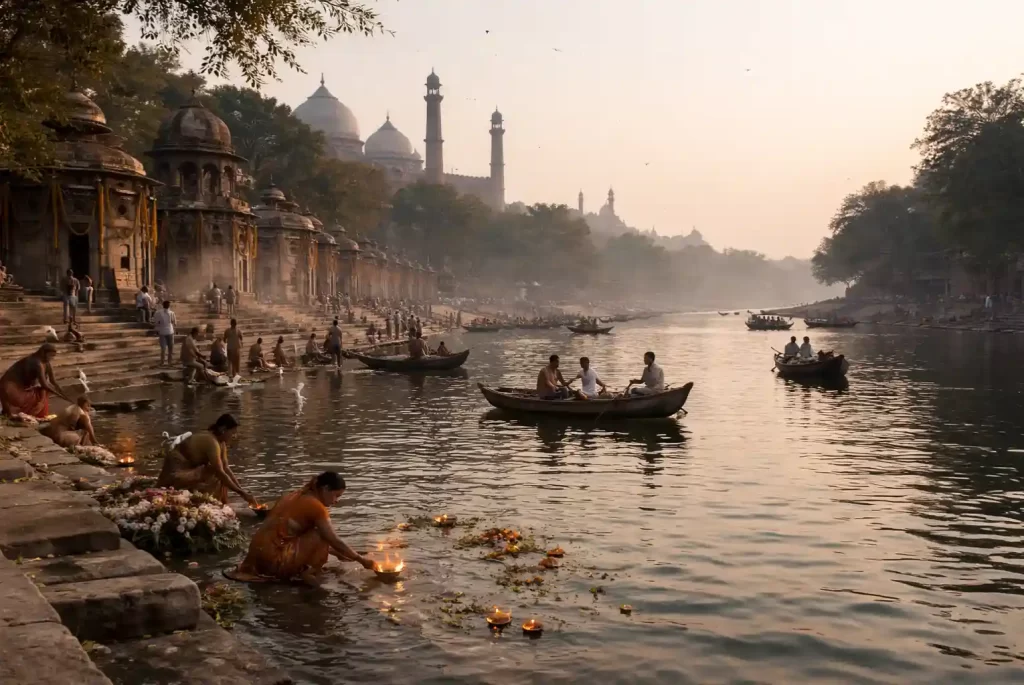
A River That Once Breathed Life into a City
There is a particular kind of silence that settles over a forgotten river. Not the silence of peace, but the silence of neglect, the quiet that follows when a city turns its back on the very water that gave it life. The Yamuna River in Delhi is one such river. For centuries, it was not just a body of water. It was an identity, a lifeline, a sacred presence that shaped the culture, architecture, art, and daily rhythms of one of the world’s oldest living cities.
Today, the Yamuna limps through Delhi grey, overloaded with industrial waste and sewage, reduced to a shadow of its former self. But beneath the surface of this crisis lies a rich, layered river culture that has been quietly erased from the city’s memory. To understand Delhi, you must first understand what it has lost.
The Ancient Bond Yamuna Through the Ages
From Vedic Verses to Mughal Paintings
The history of the Yamuna River in Delhi stretches back thousands of years. In the Rigveda, the river is celebrated as a divine gift, sister to the god Yama and daughter of the sun god Surya. The sacred Yamuna was more than a religious symbol she was a practical necessity. Early settlers chose her banks because of fertile soil, abundant fish, and the promise of fresh water through seasons of scorching heat.
By the time the Mughals arrived, the Yamuna had become a centrepiece of imperial imagination. Babur described her banks as lush and inviting. Shah Jahan built the Red Fort with its eastern walls deliberately facing the river a deliberate architectural gesture of reverence. Mughal miniature paintings show courtiers picnicking on her banks, boats gliding past mango groves, and ghats alive with bathers and traders. The cultural significance of the Yamuna in Old Delhi was woven into every layer of public and private life.
The Living Ghats Heartbeats of a River Culture
Festivals That Belonged to the River
The Yamuna ghats of Delhi were once buzzing social spaces. Nigambodh Ghat, one of the city’s oldest, was not only a cremation ground but also a place of prayer, conversation, and community. Each ghat had its own identity; some drew pilgrims, others drew washermen, fishermen, or vendors selling marigold garlands and clay lamps.
The most vivid expression of this Delhi riverfront heritage was the festival calendar tied to the river. Chhath Puja, a festival in honour of the sun god transformed the ghats into seas of light every October. Kartik Snan, the ritual dawn bath on the full moon of the Kartik month, drew thousands. These were not just religious events; they were the city’s way of remembering its bond with the water. For the communities of the riverbank, skipping these rituals was unthinkable. They were identity itself.
The People of the Yamuna Forgotten Communities
History tends to focus on emperors and architects. But the true keepers of any riverine culture in India are the ordinary people whose lives revolve around the water. Along the Yamuna, these were fishermen, ferrymen, washermen, and farmers who cultivated the fertile Yamuna khadar the floodplain between the river’s banks and the raised city beyond.
The Nishad community, one of Delhi’s oldest river-dwelling groups, has fished the Yamuna for generations. Their knowledge of the river, its moods, its tides, its fish is an oral encyclopaedia passed down father to son. The khadar farmers grew vegetables on the river’s edge, using the silt deposited by seasonal floods as natural fertiliser. These were sustainable, intelligent ways of living with a river, refined over centuries.
Today, many of these river communities in Delhi have been displaced, their homes demolished to make way for roads, sports complexes, and concrete embankments. Their knowledge, and with it, a living archive of the river, is being lost quietly, without ceremony.
Folklore, Music, and Art Born on the Riverbanks
A river that sustains life also inspires art. The Yamuna has been the subject of thumri, kajri, and a variety of North Indian folk songs for centuries. Classical musicians of the Agra and Delhi gharanas frequently referenced the river in their compositions, her name appearing in bandishes as naturally as a lover’s. Seasonal boat songs sung by ferrymen have never been formally recorded; most exist only in the fading memories of elders.
Painters and poets from the Mughal era onward captured the river’s grace. Even early British watercolourists, arriving with colonial ambitions, could not help but record the Yamuna’s visual splendour at dusk, wide and glittering, framed by domes and minarets. This Delhi’s water history runs through its creative legacy, even if modern Delhi has forgotten to acknowledge it.
Architecture That Faced the River
The Delhi riverfront heritage is also visible or was visible in the city’s-built environment. The Red Fort’s original design made no sense without the Yamuna running along its eastern wall. Shah Jahan intended his imperial citadel to be approached from the river, its reflection shimmering in the water below. Today, a road, a car park, and a concrete embankment stand where the river once lapped.
Salimgarh Fort, the older structure adjacent to the Red Fort, was built on an island in the river. That island no longer exists — the Yamuna has moved eastward, squeezed by encroachments on both sides. The stepwells and water kunds (tanks) that once dotted the riparian landscape are mostly buried or forgotten, their engineering genius now invisible beneath tarmac and buildings.
How Delhi Turned Its Back on the Yamuna
The relationship between Delhi and its river began to fracture in the twentieth century. Rapid industrialisation following Independence brought factories to the riverbanks. The unchecked growth of the city pushed sewage networks that drained directly into the river. By the 1980s, the Yamuna passing through Delhi had become one of the most polluted stretches of any river in Asia.
Urban expansion swallowed the floodplain. Yamuna pollution history is also a story of political failure promises made and broken across decades, action committees formed and dissolved, and cleanup projects launched with fanfare that achieved little. The communities of the khadar were pushed out not by the river’s floods, but by the city’s indifference. Delhi’s lost heritage was not stolen overnight. It was surrendered gradually, decision by decision.
Echoes of Revival: Can the Culture Be Reclaimed?
The question is not only whether the Yamuna can be cleaned, though that is urgent and essential. The deeper question is whether Delhi can remember what it once had and choose to want it back.
Grassroots movements have been working quietly along the river for years. Environmental groups, community organisations, and artists have been documenting oral histories, restoring small sections of the floodplain, and demanding accountability. Urban planners and historians who are reimagining the riverfront argue that Yamuna restoration must go beyond water quality. It must include the revival of public ghats, the return of seasonal festivals, and the recognition of river communities as custodians not encroachers of the floodplain.
Cities like Seoul, which restored the Cheonggyecheon stream after decades of neglect, and Paris, which has been working to make the Seine swimmable, show that rivers can be reclaimed. The will and vision are what it takes. Delhi has both the historical depth and the civic energy to do the same — if it chooses to listen.
Conclusion: Listening to the Whispers
The Yamuna still flows through Delhi. Diminished, poisoned, and largely ignored — but flowing. In that persistence, there is something worth honouring. The river has not given up on the city, even if the city has, for a long time, given up on the river.
To remember the Yamuna civilisation is not an act of nostalgia. It is an act of civic responsibility. The river shaped this city’s culture, fed its people, inspired its art, and gave its architecture meaning. Restoring that relationship slowly, deliberately, and with deep respect for the communities that never stopped living with the river is perhaps the most important thing Delhi can do for its own future.
If you walk to Nigam Bodh Ghat at dawn and listen carefully, past the hum of traffic and the grey water below, you can still hear something. A whisper. The Yamuna, asking to be remembered.